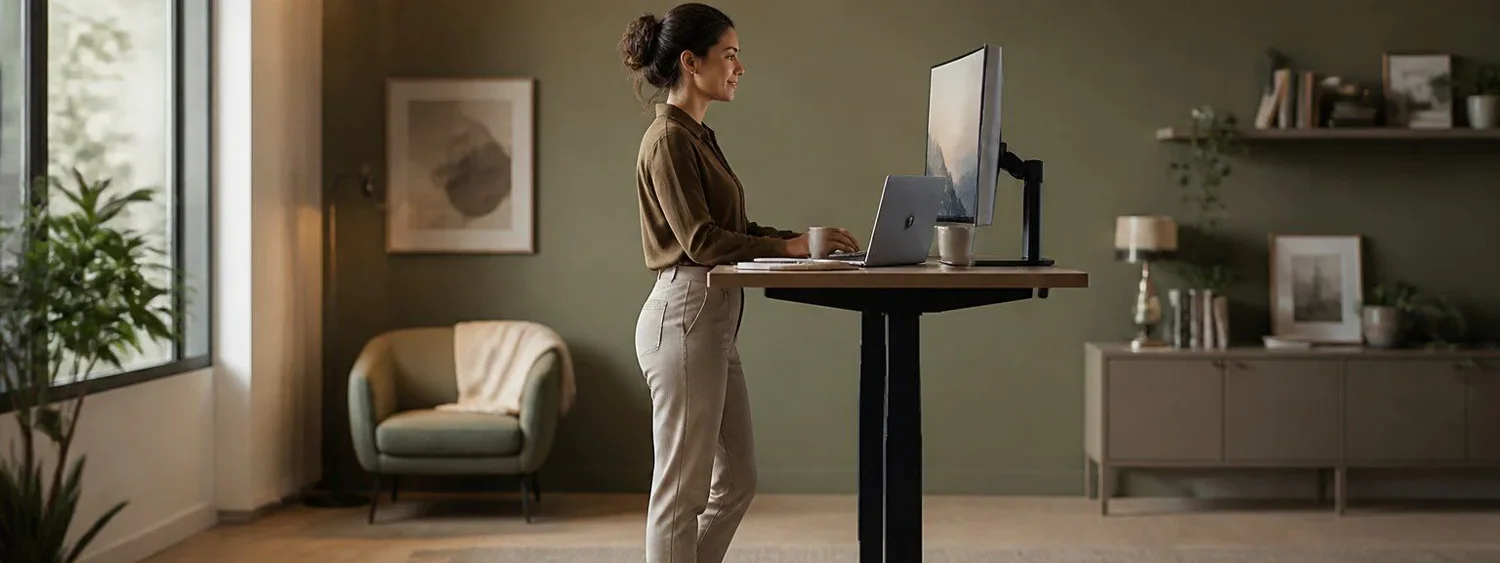
This support page focuses on height range, memory presets, and sit-stand fit for home office standing desks. Product comparisons belong on 5 Best Standing Desks for Home Office Productivity. Previous cloud article: ergonomic office chairs for back pain relief.
Height Range, Memory Presets, and Sit-Stand Fit
Productivity lens. The height range decides whether the desk can support real sitting and standing posture instead of only looking adjustable.
Posture fit. The desk should place elbows near a relaxed angle, shoulders low, screen height sensible, and wrists neutral in both sitting and standing positions. For height range, memory presets, and sit-stand fit, judge the desk by how it supports an ordinary home workday rather than by a clean showroom photo alone.
Change friction. Memory presets, smooth lifting, and simple controls matter because people avoid adjustments that feel slow, loud, or easy to overshoot. For height range, memory presets, and sit-stand fit, judge the desk by how it supports an ordinary home workday rather than by a clean showroom photo alone.
Stable workflow. A useful surface holds monitors, laptop stands, notebooks, lights, and chargers without shaking during typing or crowding the work zone. For height range, memory presets, and sit-stand fit, judge the desk by how it supports an ordinary home workday rather than by a clean showroom photo alone.
Room behavior. Check outlet reach, cable slack, wall clearance, floor protection, caster needs, and whether the desk still feels tidy in a shared room. For height range, memory presets, and sit-stand fit, judge the desk by how it supports an ordinary home workday rather than by a clean showroom photo alone.
Energy management. Standing is not the goal by itself; alternating posture, using a mat, and planning seated focus blocks keeps comfort from becoming another distraction. For height range, memory presets, and sit-stand fit, judge the desk by how it supports an ordinary home workday rather than by a clean showroom photo alone.
Value proof. Look for frame warranty, motor warranty, spare-part availability, clear dimensions, weight capacity, and reviews that mention months of daily use. For height range, memory presets, and sit-stand fit, judge the desk by how it supports an ordinary home workday rather than by a clean showroom photo alone.
Decision note. The best standing desk is the one that makes movement feel natural while keeping the work surface calm. If the setup supports both deep focus and quick posture changes, it is more likely to improve productivity over time.
Home-office checklist
Productivity lens. The height range decides whether the desk can support real sitting and standing posture instead of only looking adjustable.
Posture fit. The desk should place elbows near a relaxed angle, shoulders low, screen height sensible, and wrists neutral in both sitting and standing positions. For buyer checklist for height range, memory presets, and sit-stand fit, judge the desk by how it supports an ordinary home workday rather than by a clean showroom photo alone.
Change friction. Memory presets, smooth lifting, and simple controls matter because people avoid adjustments that feel slow, loud, or easy to overshoot. For buyer checklist for height range, memory presets, and sit-stand fit, judge the desk by how it supports an ordinary home workday rather than by a clean showroom photo alone.
Stable workflow. A useful surface holds monitors, laptop stands, notebooks, lights, and chargers without shaking during typing or crowding the work zone. For buyer checklist for height range, memory presets, and sit-stand fit, judge the desk by how it supports an ordinary home workday rather than by a clean showroom photo alone.
Room behavior. Check outlet reach, cable slack, wall clearance, floor protection, caster needs, and whether the desk still feels tidy in a shared room. For buyer checklist for height range, memory presets, and sit-stand fit, judge the desk by how it supports an ordinary home workday rather than by a clean showroom photo alone.
Energy management. Standing is not the goal by itself; alternating posture, using a mat, and planning seated focus blocks keeps comfort from becoming another distraction. For buyer checklist for height range, memory presets, and sit-stand fit, judge the desk by how it supports an ordinary home workday rather than by a clean showroom photo alone.
Value proof. Look for frame warranty, motor warranty, spare-part availability, clear dimensions, weight capacity, and reviews that mention months of daily use. For buyer checklist for height range, memory presets, and sit-stand fit, judge the desk by how it supports an ordinary home workday rather than by a clean showroom photo alone.
Decision note. The best standing desk is the one that makes movement feel natural while keeping the work surface calm. If the setup supports both deep focus and quick posture changes, it is more likely to improve productivity over time.
Sit-stand rehearsal
Productivity lens. The height range decides whether the desk can support real sitting and standing posture instead of only looking adjustable.
Posture fit. The desk should place elbows near a relaxed angle, shoulders low, screen height sensible, and wrists neutral in both sitting and standing positions. For sit stand rehearsal for height range, memory presets, and sit-stand fit, judge the desk by how it supports an ordinary home workday rather than by a clean showroom photo alone.
Change friction. Memory presets, smooth lifting, and simple controls matter because people avoid adjustments that feel slow, loud, or easy to overshoot. For sit stand rehearsal for height range, memory presets, and sit-stand fit, judge the desk by how it supports an ordinary home workday rather than by a clean showroom photo alone.
Stable workflow. A useful surface holds monitors, laptop stands, notebooks, lights, and chargers without shaking during typing or crowding the work zone. For sit stand rehearsal for height range, memory presets, and sit-stand fit, judge the desk by how it supports an ordinary home workday rather than by a clean showroom photo alone.
Room behavior. Check outlet reach, cable slack, wall clearance, floor protection, caster needs, and whether the desk still feels tidy in a shared room. For sit stand rehearsal for height range, memory presets, and sit-stand fit, judge the desk by how it supports an ordinary home workday rather than by a clean showroom photo alone.
Energy management. Standing is not the goal by itself; alternating posture, using a mat, and planning seated focus blocks keeps comfort from becoming another distraction. For sit stand rehearsal for height range, memory presets, and sit-stand fit, judge the desk by how it supports an ordinary home workday rather than by a clean showroom photo alone.
Value proof. Look for frame warranty, motor warranty, spare-part availability, clear dimensions, weight capacity, and reviews that mention months of daily use. For sit stand rehearsal for height range, memory presets, and sit-stand fit, judge the desk by how it supports an ordinary home workday rather than by a clean showroom photo alone.
Decision note. The best standing desk is the one that makes movement feel natural while keeping the work surface calm. If the setup supports both deep focus and quick posture changes, it is more likely to improve productivity over time.
Final fit buffer
Also test the desk against the real room: door swing, rug thickness, outlet location, cable length, monitor arms, laptop stands, lamps, plants, notebooks, and whether the background still looks professional for video calls. A standing desk can be technically strong but still feel wrong if it disrupts the room or creates messy cables.
Think through the first month of ownership. The best productivity setup is not standing all day; it is switching positions before fatigue turns into distraction. Memory presets, reminders, a comfortable mat, and a nearby chair make the habit easier to repeat through meetings, writing sessions, and admin work.
Finally, compare the frame to the equipment load. Dual monitors, heavy desktops, clamp accessories, speakers, printers, and monitor arms can change wobble and lift behavior. A desk with generous capacity and stable legs gives the worker confidence to adjust height without clearing the surface every time.
As a last pass, picture the ordinary afternoon slump. The desk should make it easy to rise, reset posture, clear a small writing area, and return to focused work without fuss. If the controls, cable plan, or surface layout makes that moment annoying, the productivity benefit will fade quickly.
For shared homes, also consider sound, visual clutter, and transition timing. A desk that lifts quietly, keeps chargers organized, and lets the worker switch posture during natural breaks will support productivity better than one that turns every adjustment into a noticeable event.
When the room and sit-stand routine are clear, compare the full standing-desk shortlist here: 5 Best Standing Desks for Home Office Productivity.